
| Volume 12 |
Dhul Qadah – Dhul Hijjah 1445 AH |
| Issue 47 | June 2024 AD |
| ISSN 24102237 |
Editorial
The Kuwaiti Constitutional Court reaffirms the right of government agencies to set and change the costs of services provided
By: Prof. Badria A. Al-Awadi
Editor-in-Chief
As part of a strategy to review the state’s financial policies, enhancing its resources and reducing waste, the government has announced a set of plans and programs over the past few months to achieve this goal. This included calling on various ministries and government agencies to take steps to review the costs of services provided to the public and raise them to reduce the burden on the state, limit the existing financial deficit, and allow for contributions and partnerships in financing the development of these services. These plans and procedures also include setting new costs for some services that were previously provided free of charge.
The Kuwaiti Constitutional Court reaffirms the right of government agencies to set and change the costs of services provided
Chief-in-Editor Prof. Badria A. Al-Awadi
As part of a strategy to review the state’s financial policies, enhancing its resources and reducing waste, the government has announced a set of plans and programs over the past few months to achieve this goal. This included calling on various ministries and government agencies to take steps to review the costs of services provided to the public and raise them to reduce the burden on the state, limit the existing financial deficit, and allow for contributions and partnerships in financing the development of these services. These plans and procedures also include setting new costs for some services that were previously provided free of charge.
While these measures were met with satisfaction and positive interaction from many social and economic circles because they reflect government policies aimed at rationalizing spending, developing services, and achieving sustainability principles, they raised legal discussions – old and new – regarding the constitutionality of raising some of the existing costs due to ongoing economic developments, and government agencies imposing new costs on services that were provided to the public free of charge or new services. This is in different interpretations and explanations of the text of Article (134) of the Constitution, which states that: “The establishment, amendment, and cancellation of general taxes shall only be by law. No one shall be exempted from paying all or some of them except in the cases specified by law. No one may be required to pay other taxes, fees, and costs except within the limits of the law.”
Amidst this ongoing legal debate, and in a recent ruling issued in a lawsuit of unconstitutionality referred to it by the Court of Appeal, and registered with it under No. 2 of 2024 “Constitutional – which relates to an appeal filed by the Union of Private Medical Professions against the constitutionality of the Minister of Health’s Decision No. 196 of 2022, issued on May 17, 2022, and published in the Official Gazette (Kuwait Today) on May 29, 2022, regulating the treatment of medical waste, including determining the schedule of its material costs and the company responsible for it, the Kuwaiti Constitutional Court reiterated the constitutional right of ministries and government agencies to set the price or equivalent for the services they provide according to their value and the nature of the economic situation.
The Court affirmed that the Ministry of Health’s decision to impose a fee for medical waste treatment services is not subject to the provisions of Article (134) of the Constitution, and is not considered a fee that must be issued by law. The Court indicated in the grounds for its ruling that: “The meaning of Article (134) of the Constitution is that no one may be required to pay fees except within the limits of the law. What is meant by fees is what a public body imposes in exchange for specific services it provides to those who request them. In assessing them, the cost of the service is not taken into account, as their amount is, as a general rule, fixed for all beneficiaries of these services, and throughout the validity of the legislative instrument that imposed them.”
The Court added that according to this interpretation, fees: “differ from the price of the product or the fee for the service collected by the entities responsible for managing state property, as the price or fee is paid to a public economic facility that is managed by one of the entities according to economic management methods, and is determined according to purely economic criteria. It is subject to changes imposed by the nature of economic conditions, and may expand to include changes resulting from negotiations between the requester of the product or service and the economic facility. It may even change according to the nature of the transactions in terms of their size, quantity, or the conditions of their performance.”
The Court pointed out that based on the fact that the ministerial decision included a schedule of medical waste disposal costs according to their size, and that the cost of treating the waste, medicines and medical consumables agreed upon in that contract was not permitted to exceed the maximum limit stated in the appendix attached to the decision, “what the (ministerial) decision included regarding the cost of treating the aforementioned waste is not considered a fee, as it is not a fixed amount that all health facilities are obligated to pay, but rather it is estimated according to purely economic considerations that take into account the nature and quantity of the waste required to be treated. The reality of this cost is that it is the price of the service that the medical facility requests from the company assigned by the Ministry of Health to manage the treatment plant to treat its waste, so it does not fall within the concept of fees that can only be established within the limits of the law…”
Thus, this criterion, which the Constitutional Court has renewed its adoption of in distinguishing between fees falling within the framework of Article (134) of the Constitution and the costs of services provided, is distinguished by being an objective criterion subject to specific and defined controls, as indicated in the grounds of the aforementioned ruling, which contributes to determining and clarifying the effects and provisions resulting from it.
Content
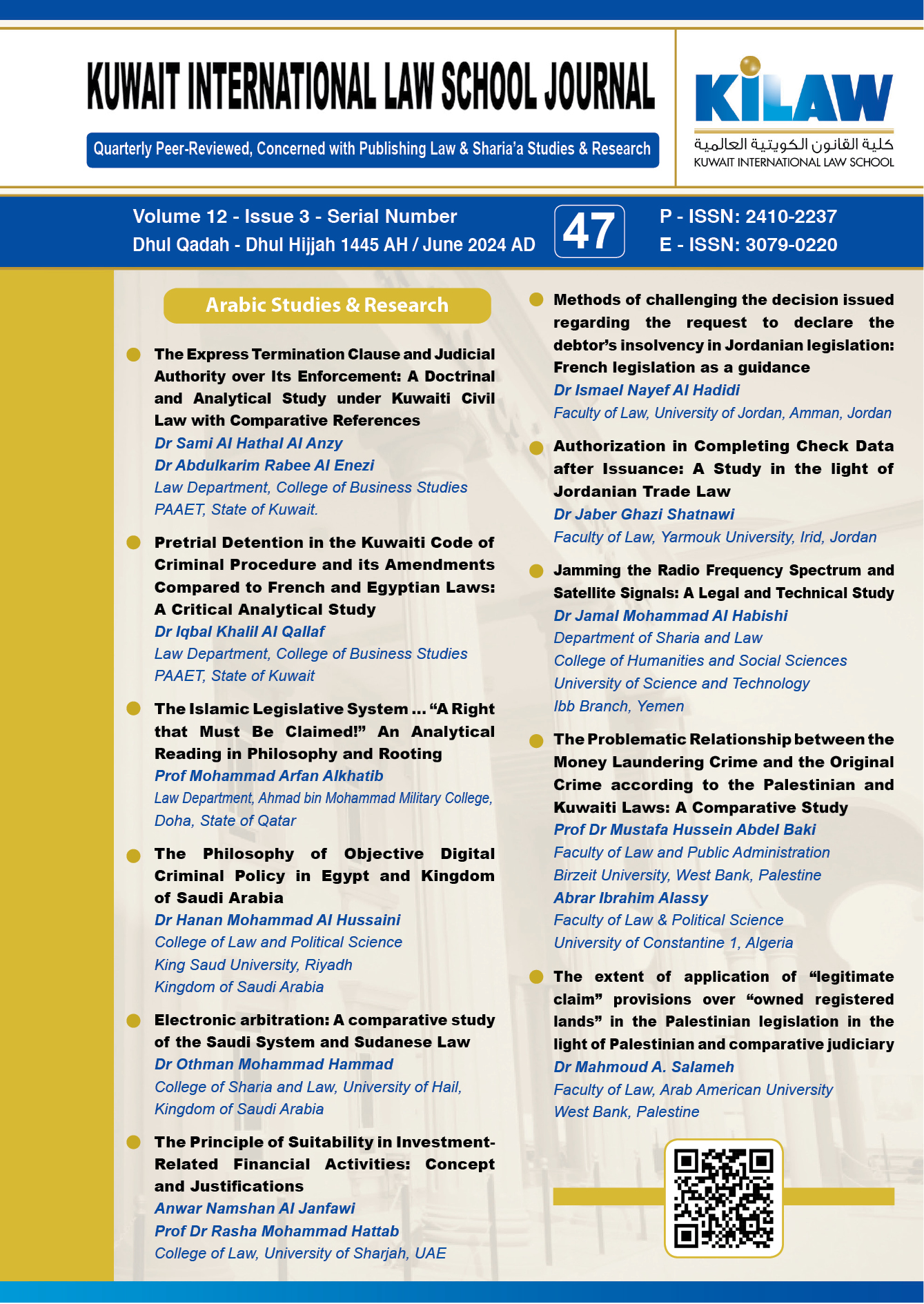
Arabic Studies and Research
الشرط الفاسخ الصريح وسلطة القاضي إزاءه: دراسة تحليلية تأصيلية في القانون المدني الكويتي مع الإشارة إلى بعض القوانين المقارنة
د. سامي الهذّال العنزي
باحث أول
أستاذ القانون المدني المساعد
قسم القانون، كلية الدراسات التجارية، الهيئة العامة للتعليم التطبيقي والتدريب، دولة الكويت
د. عبدالكريم ربيع العنزي
باحث ثان
أستاذ القانون المدني المشارك
قسم القانون، كلية الدراسات التجارية، الهيئة العامة للتعليم التطبيقي والتدريب، دولة الكويت
الحبس الاحتياطي في قانون الإجراءات الجزائية الكويتي وتعديلاته مقارنة بالقانونين الفرنسي والمصري: دراسة تحليلية نقدية
د. إقبال خليل القلاف
أستاذ القانون الجزائي المساعد
قسم القانون، كلية الدراسات التجارية
الهيئة العامة للتعليم التطبيقي والتدريب، دولة الكويت
المنظومة التشريعية «الإسلامية» … حقٌ يستوجب المُطالبة!: قراءة تحليلية في الفلسفة والتأصيل
أ. د. محمد عرفان الخطيب
أستاذ القانون المدني, قسم القانون
كلية أحمد بن محمد العسكرية
الدوحة، دولة قطر
فلسفة السياسة الجنائية الرقمية الموضوعية في مصر والمملكة العربية السعودية
د. حنان محمد الحسيني أحمد
أستاذ القانون الجنائي المشارك
كلية الحقوق والعلوم السياسية
جامعة الملك سعود، الرياض, المملكة العربية السعودية
التحكيم الإلكتروني: دراسة مقارنة في النظام السعودي والقانون السوداني
د. عثمان محمد حماد
أستاذ القانون التجاري المشارك
كلية الشريعة والقانون، جامعة حائل
المملكة العربية السعودية
مبدأ الملاءمة في مزاولة الأنشطة المالية المتعلقة بالاستثمار المفهوم والمبررات
أ. أنوار نمشان الجنفاوي
باحثة دكتوراه
كلية القانون، جامعة الشارقة
الإمارات العربية المتحدة
أ. د. رشا محمد حطاب
أستاذ القانون التجاري
كلية القانون، جامعة الشارقة
الإمارات العربية المتحدة
طرق الطعن في القرار الصادر بخصوص طلب إشهار إعسار المدين في التشريع الأردني استرشاداً بالتشريع الفرنسي
د. إسماعيل نايف الحديدي
أستاذ القانون التجاري المساعد
كلية الحقوق، الجامعة الأردنية
التفويض في استكمال بيانات الشيك بعد إصداره: دراسة في ضوء أحكام قانون التجارة الأردني
د. جبر غازي شطناوي
أستاذ القانون التجاري المساعد
كلية القانون، جامعة اليرموك
إربد، الأردن
التشويش على طيف الترددات الراديوية وإشارات الأقمار الصناعية: دراسة قانونية وفنية
د. جمال محمد فارع الحبيشي
أستاذ القانون الدولي العام المساعد
رئيس قسم الشريعة والقانون
كلية العلوم الإنسانية والاجتماعية
جامعة العلوم والتكنولوجيا، فرع إب، اليمن
علاقة جريمة غسل الأموال بالجريمة الأصلية في التشريعات الفلسطينية والكويتية: دراسة مقارنة
أ. د. مصطفى حسين عبدالباقي
أستاذ القانون الجنائي
كلية الحقوق والإدارة العامة
جامعة بيرزيت، الضفة الغربية، فلسطين
أ. أبرار إبراهيم عاصي
باحث دكتوراه
كلية الحقوق والعلوم السياسية
جامعة قسنطينة1، الجزائر
مدى تطبيق أحكام الزعم الشرعي على الأراضي الملك المسواة في التشريع الفلسطيني في ضوء أحكام القضاء الفلسطيني والمقارن
د. محمود عبدالمحسن سلامة
أستاذ القانون المدني المساعد
كلية الحقوق، الجامعة العربية الأمريكية
جنين، الضفة الغربية، فلسطين